
Ferrari’s preparations for the 2026 F1 season have reportedly hit an unexpected timing issue. Sources in Italy suggest the Maranello team is running slightly behind schedule on its all-new car, the SF-26, despite an early strategic shift of resources toward the new regulations.
The Scuderia committed to the 2026 project by the end of April last year after McLaren’s early-season dominance made a title challenge unrealistic. With sweeping technical changes, including new power units, lighter and narrower cars, and a 50-50 split between combustion and electrical power, Ferrari also chose to sacrifice 2025 upgrades to maximize wind-tunnel and design time for the SF-26.
According to recent reports, the SF-26 chassis has already been homologated, and both Charles Leclerc and Lewis Hamilton have completed seat fittings. However, with pre-season testing less than two weeks away, the first full engine fire-up is still pending, raising questions about Ferrari’s aggressive early switch.
Italian journalist Giuliano Duchessa, who works for AutoRacer, wrote on X:
“The Ferrari drivers have done the seat fitting, the chassis is officially approved. The fire-up is still missing, which will arrive shortly. Our information suggests that there’s a delay in the schedule. We’ll be hearing about it.”
The update has drawn attention because several rival manufacturers like Aston Martin and Audi have already completed initial power-unit start-ups. Meanwhile, Ferrari faces the added complexity of supplying not only its own works team but also Haas and newcomer Cadillac under the 2026 regulations. Therefore, the workload at Maranello is substantial.
Any delay inevitably fuels concerns, given Ferrari’s recent history of ambitious regulation resets that have not always delivered immediate results. The reports come at the back of a difficult 2025 campaign where the Prancing Horse finished fourth in the Constructors’ Championship, its worst result in five years.
Charles Leclerc claimed all seven of the team’s podiums, but the car was rarely a race-winning threat. Lewis Hamilton, in his first season in red, endured the first podium-less year of his career, struggling for consistency and balance as the team’s development focus gradually shifted away from the SF-25. Despite finishing behind both Mercedes and Red Bull, Ferrari team principal Fred Vasseur has remained firm that the early switch was the correct strategic move.
“It’s the best preparation for 2026. But the most important of this call is that we agreed quite early that we would put a maximum of energy on the future,” he told F1
Ferrari has already confirmed that the SF-26 will be officially unveiled on January 23 at Maranello, marking what it has branded “a new era” for the team and potentially the final realistic title window for Hamilton to chase a record-breaking eighth world championship.
Fred Vasseur explains Ferrari’s early switch from 2025 to 2026
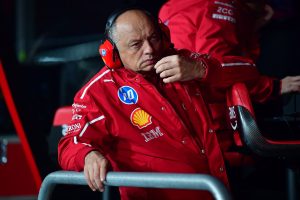
McLaren won 12 of the first 15 races in 2025 and wrapped up both championships, creating a performance and points gap that Ferrari deemed too big to close through in-season development alone. Team principal Fred Vasseur has previously clarified, after the Abu Dhabi Grand Prix, why Ferrari chose to pivot so decisively toward the 2026 project, even while a full season remained to be raced.
“McLaren was so dominating in the first four or five events that we realized it would be very difficult for 2025,” Vasseur added via F1. “It meant that we decided very early in the season, I think it was the end of April, to switch to ’26. It was a tough call. Perhaps I also underestimated a little bit the call on the psychological side, because when you still have 20 races to go, or 18 races to go.”
He stressed that the decision was not imposed from the top, but was agreed collectively across the organization.
“This decision was shared by everybody in the team. At one stage, you look at the championship and say, ‘Okay, it will be very difficult to come back on McLaren’… So you say, ‘Okay, let’s focus the resources we have in the wind tunnel on 2026.”
Ferrari will get its first on-track indication of whether that gamble has paid off during a private test at the Circuit de Barcelona-Catalunya from January 26 to 30.
